Building Chemicals and Electrical Materials: A Project Guide
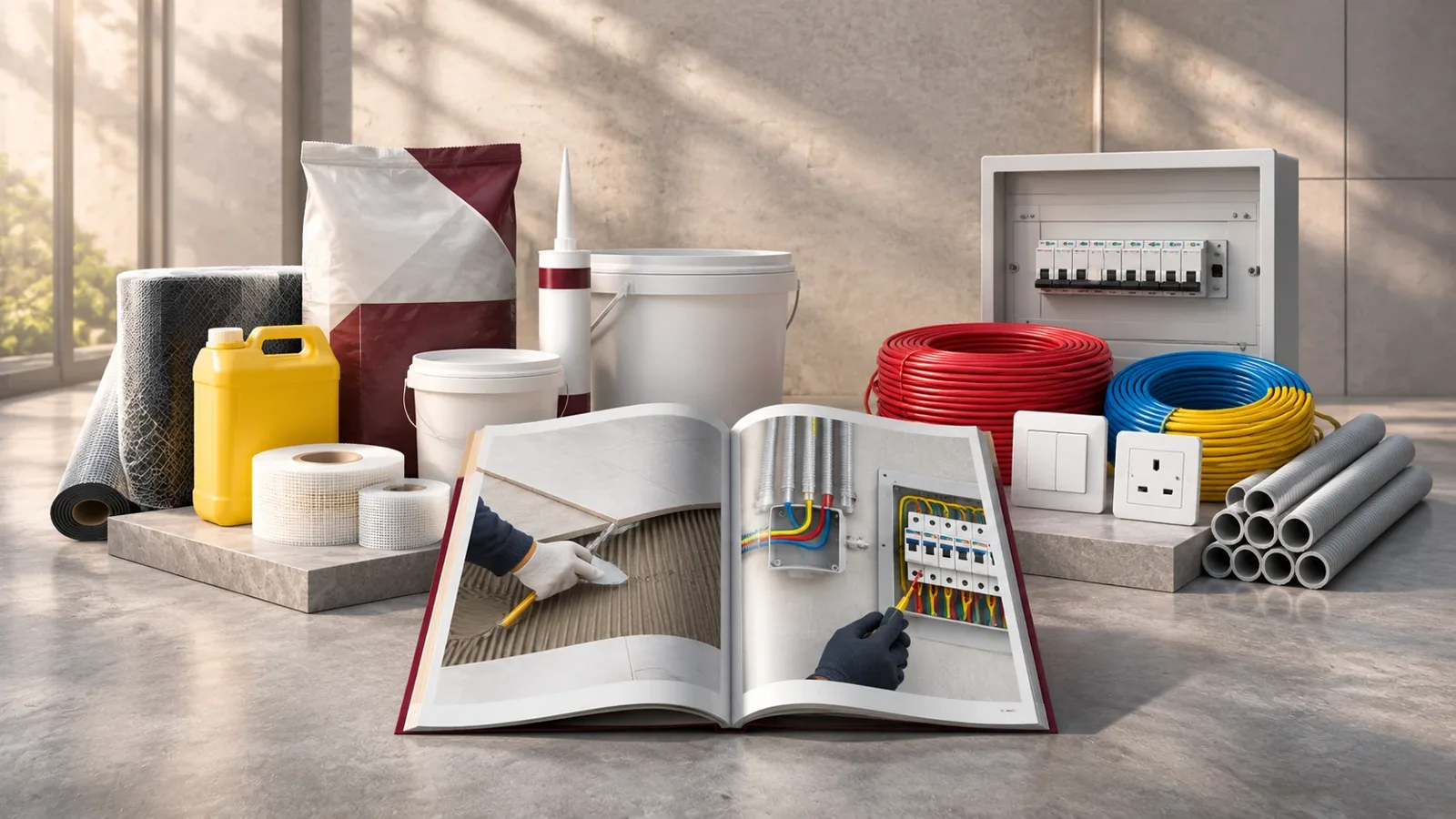
The materials hidden behind the finish determine a building's lifespan. Debonded tiles, water leaks or constantly tripping breakers are usually the result of a material that does not suit its application.
Tile Adhesives
Cementitious tile adhesives are classified under European standard EN 12004. Reading the code on the bag removes the guesswork:
| Code | Meaning | When you need it |
|---|---|---|
| C1 | Standard cementitious adhesive | Small-format ceramic on interior surfaces |
| C2 | Improved adhesive with higher bond strength | Porcelain, large formats and exterior areas |
| T | Slip-resistant | Wall tiling |
| E | Extended open time | Hot climates and large areas |
| S1 / S2 | Deformable, absorbs movement | Facades, sun-exposed roofs and underfloor heating |
Example: C2TE S1 denotes an improved, slip-resistant adhesive with extended open time and flexibility, suitable for most porcelain applications in the Saudi climate.
Grouts
- Cementitious grout (CG2): Resistant to abrasion and water absorption; suits most spaces.
- Epoxy grout (RG): Non-absorbent and stain-proof; the choice for bathrooms, commercial kitchens and pools.
Waterproofing
Waterproofing is essential in bathrooms, kitchens, roofs, water tanks and pools.
- Flexible cementitious waterproofing: Applied directly beneath tiles in interior wet areas.
- Liquid membranes: Form a continuous, joint-free layer; ideal for detailed surfaces.
- Bituminous membranes: For roofs and foundations exposed to water and ground moisture.
Details matter most: wall-to-floor corners and penetrations around drains and pipes are treated with dedicated waterproofing tapes, as they are the source of most leaks.
Electrical Materials
- Cables: Cable size is determined by load and run length; copper remains the most common choice for residential wiring.
- Circuit breakers: One breaker per circuit, rated to suit the cable, plus residual current devices (RCDs) on bathroom, kitchen and outdoor circuits.
- Switches and sockets: Splash-protected sockets in wet areas, positioned according to furniture and appliance layouts.
- Compliance: Ensure products meet the requirements of the Saudi Standards, Metrology and Quality Organisation (SASO).
What Makarm Offers
Makarm's building materials division serves contractors, projects and retailers, supplying building chemicals from brands including MAPEI, Sika and Saint-Gobain Weber, together with hand and power tools and furniture and kitchen accessories. In electrical materials, Makarm is a main distributor for Alfanar and Riyadh Cables.
Explore the range on the Building & Electrical Materials page →
Tools, Water Heaters and Electrical Accessories
Start with the work schedule to identify tools for measuring, fastening or finishing, and check accessory compatibility. For water heaters, identify the points of use and installation space, then use the model data sheet to check capacity and installation requirements. For plugs, sockets, switches, wires and cables, share the approved schedule and specifications for review by a qualified professional.
Frequently Asked Questions
Which adhesive suits large-format porcelain?
An improved cementitious adhesive (C2), preferably deformable (S1), with full coverage on both the tile back and the substrate.
Is waterproofing the bathroom floor enough?
No. Waterproofing should extend at least 30 cm up the walls, and to splash height or higher in the shower area.
What are the benefits of epoxy grout?
It does not absorb water or stains and resists chemicals and mould, keeping its colour and cleanliness for longer.
Why do I need an RCD?
It cuts the power the moment it detects current leakage, making it the most important protection against electric shock in wet areas.